|
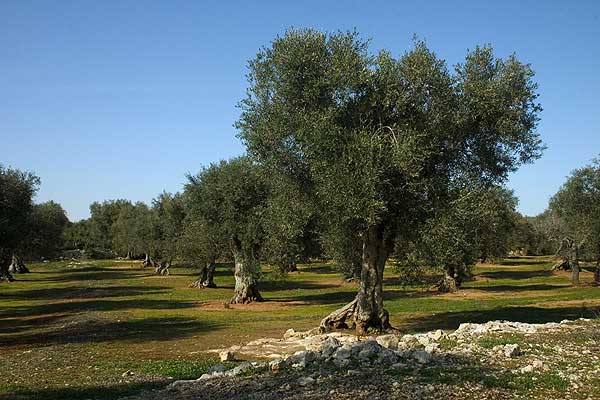
Country lanes, at times bordered by dry stone walls meander out of sight on the estates that encircle the farms. All around, thousands of monumental olive trees. The slanting rays of the sun settle on these giants, caressing their spectacular foliage. They are ogliarola and cime di Mola, centuries-old olive trees that can exceed ten metres in height, with crowns twenty metres in diameter and a harvest of a tonne and a half of olives. Some were planted more than 700 years ago by Basilian monks who fled from the East and began to transform underground caves and hermits' cells into oil mills.
A few kilometres from Fasano, on the outermost reaches of the Murge, between the lands of Bari and those of ancient Otranto, the first stage of an itinerary begins, whose goal is to discover what the Greeks called elaion, the Latins oleum, and which for all the populations of the Mediterranean was true liquid gold. Olive oil has been used for massaging Olympic athletes, anointing kings, perfuming pharaohs and filling ancient coffers. And, of course, for enhancing all food with a flavour steeped in history. Here in the hills of Brindisi, a road has been dedicated to "his majesty" olive oil, perhaps the first in Italy. It runs for about 150 kilometres, linking the municipalities of Carovigno, Ceglie Messapica, Cisternino, Fasano, Ostuni, San Michele Salentino, San Vito dei Normanni, and Villa Castelli, passing olive mills, rural villages and, above all, old farmsteads. For it is farms that are Puglia's historical "olive oil industries", located at the centre of vast lordly estates whose prestige was not measured in acres, but in the number of olive trees. . . >>>
Farmholiday Apuglia |
|